





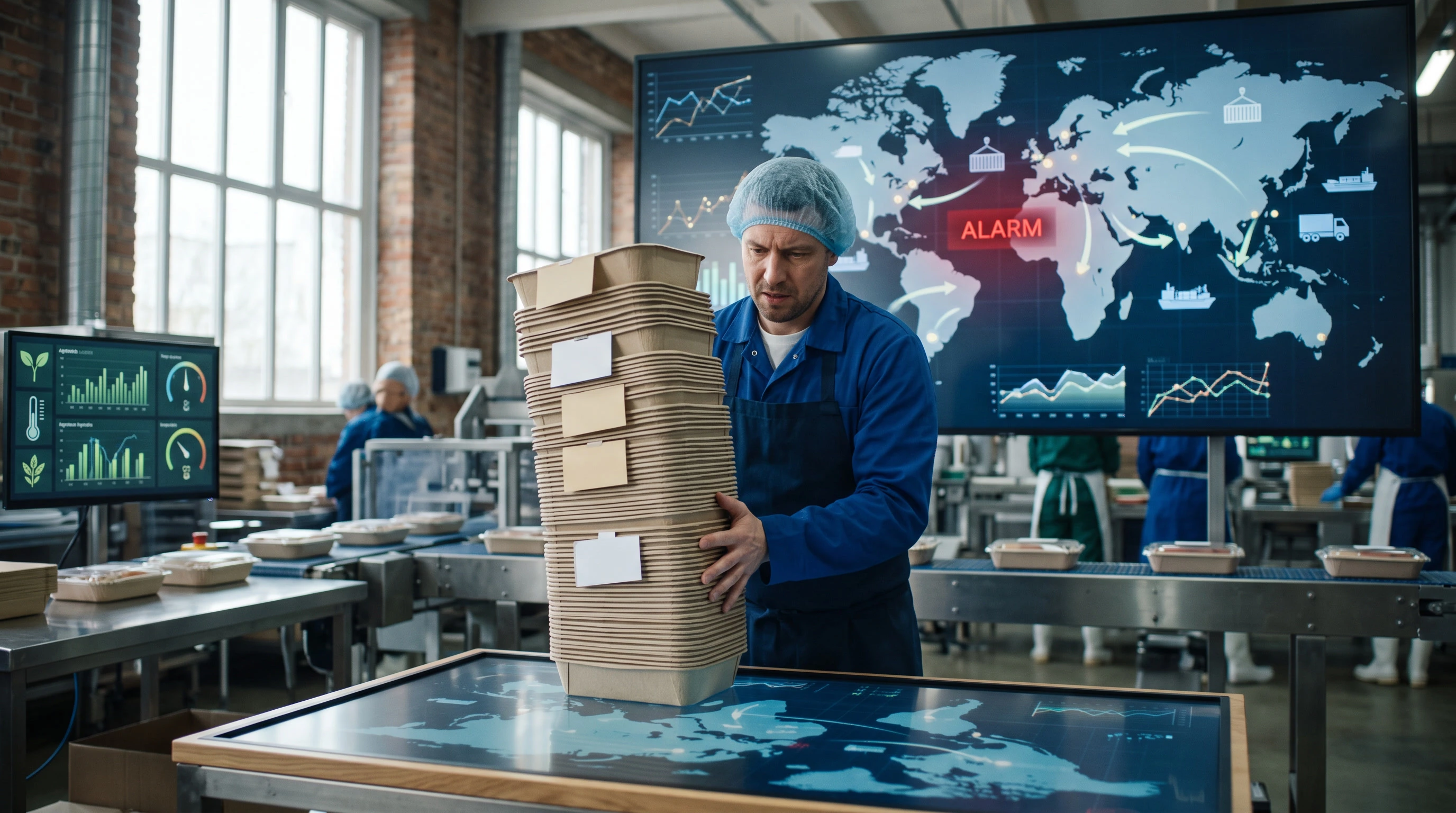
The market signal is awkwardly clear. Just as the EU’s Packaging and Packaging Waste Regulation entered implementation on August 12, 2026, food manufacturers were already spending heavily to prepare for another environmental rule change, with the EU Deforestation Regulation due in December 2026 after years of delay [1]. At the same time, global buyers are still searching for reliable supply chains and new growth markets across Asia, a search that has strengthened China’s position as a sourcing destination rather than weakened it [2]. The immediate tension is not philosophical. It is operational: Europe is asking for cleaner, more knowable product systems while food trade remains structured around scale, distance and uneven data quality.
That makes compliance feel less like an isolated legal bill and more like a redesign cost. One source says food companies are investing in traceability systems for cocoa, coffee, soy and palm oil in order to support compliance, resilience and supply security [1]. Many manufacturers also describe EUDR and wider ESG spending as a long-term business investment rather than a pure drag on earnings [1]. That is the optimistic reading. The harder reading is that once traceability, geolocation, supplier verification and reporting begin to stack up, environmental compliance stops being a side function and starts shaping procurement itself [1]. In a sector where margins are habitually thin, that shift matters as much as any change in labour or factory economics.
The import side of the equation is moving in the opposite direction: towards more options, more volume and more commercial temptation. SIAL Shanghai 2026 drew 183,302 industry professionals from 132 countries and regions and generated more than USD 14 billion in intended onsite transactions, a result framed as evidence of continued appetite for cross-border sourcing and for categories such as healthy snacks, functional foods, clean-label products, premium beverages and food-as-medicine solutions [2]. Attention is now shifting to SIAL Guangzhou, scheduled for September 3 to 5, 2026, with organisers positioning it as South China’s largest international sourcing platform for food and beverage professionals [2]. For European manufacturers facing packaging and land-use scrutiny, that creates a paradox: the global marketplace is becoming more commercially attractive at the very moment compliance rewards tighter control.
This is where the argument for AI usually enters, but the supplied evidence does not justify calling it the only viable solution. What the sources do show is that companies are buying traceability capacity because they need better risk visibility and stronger supplier relationships [1]. They also show that smallholder farmers face challenges around data, geolocation and compliance requirements [1]. Those are exactly the kinds of fragmented, repetitive and multi-actor problems that digital tools may help to organise. But the same evidence suggests that process discipline, supplier engagement and investment in resilient sourcing also do essential work [1]. If the data coming in is weak, automation alone cannot make the chain trustworthy.
The rural production story reinforces that point. In New Zealand, a discussion paper cited by the Helen Clark Foundation says the country’s $64.3 billion food and fibre export sector is being reshaped by agricultural technology, and that the next few years will help determine whether rural communities thrive or continue to shrink [3]. Read alongside the European compliance build-out, that is a reminder that technology adoption is never only about efficiency. It also redistributes bargaining power, determines who can stay in a market and decides which regions can meet the administrative burden of modern trade. A compliance system that assumes universal digital readiness may improve oversight while still narrowing the supplier base.
So the real commercial question is not whether environmental regulation is compatible with imports; it is whether companies can afford opaque imports any longer. The evidence here suggests large manufacturers are trying to turn compliance spending into an investment in resilience and supply security [1]. Yet the sourcing environment remains global, fast-moving and commercially seductive, especially in Asia [2]. That means the cost pressure will not disappear with a single platform purchase. It will persist as an organisational strain between the board’s demand for certainty, the buyer’s demand for supply and the producer’s uneven ability to furnish data at the required standard [1][2].
The local consequence is likely to be felt first in product selection and supplier structure. As stricter packaging and environmental rules harden into routine practice, manufacturers may favour partners that can document origin, location and process more cleanly, even if that reduces flexibility [1]. AI may become useful, perhaps even commonplace, in sorting that complexity, but the material already points to a broader truth: compliance has become a supply-chain design problem before it becomes a software problem. Companies that treat it only as a digital procurement exercise risk missing the operational reset already under way [1][3].
Yum Opinion: AI looks helpful, but the stronger lesson is that compliance now rewards simpler, more transparent supply chains rather than smarter dashboards alone.