





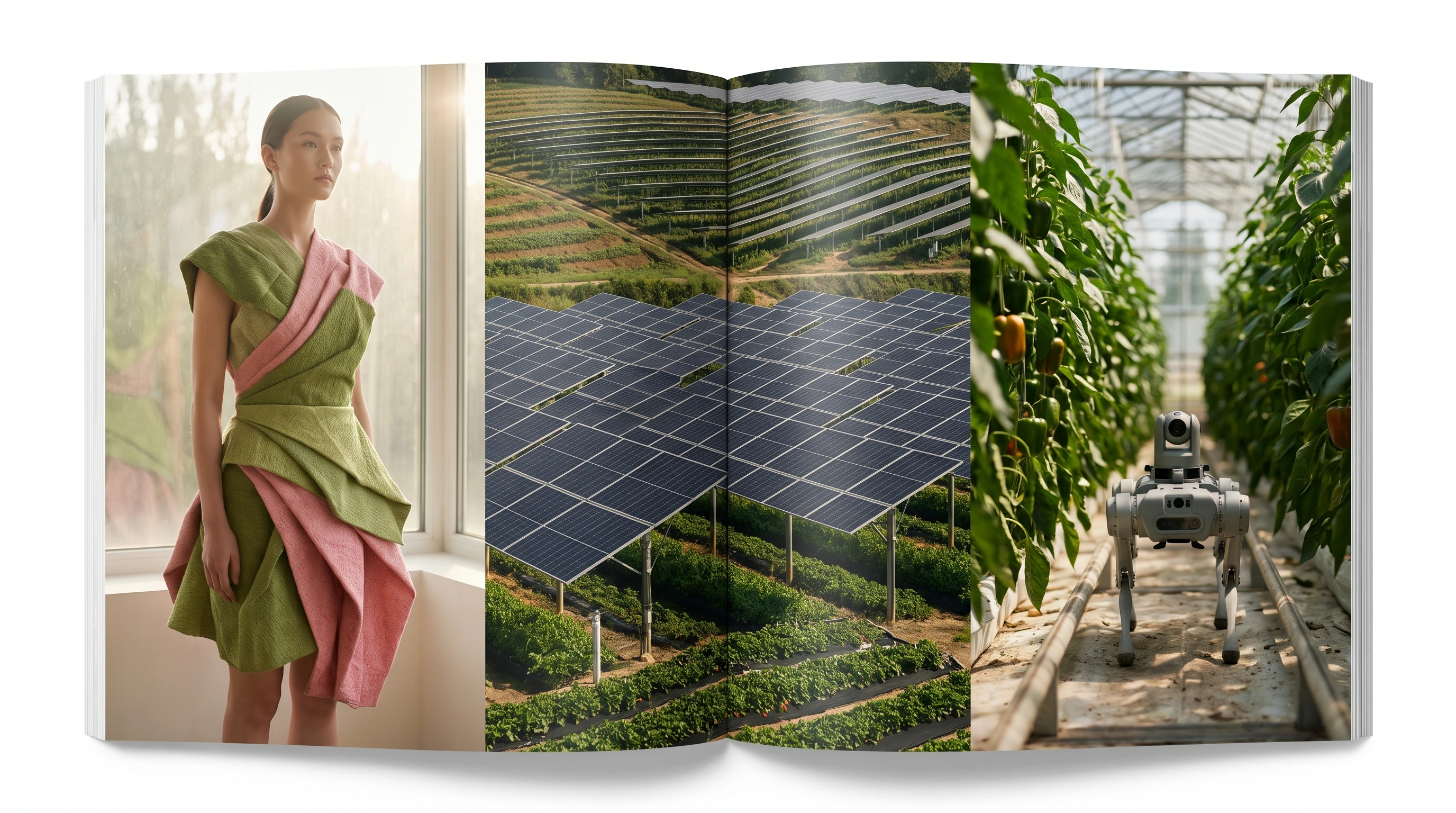
Can technology serve both spectacle and substance? Three projects unveiled or described at the end of August offer sharply different answers. Lindt & Sprüngli has collaborated with avant-garde fashion designer Joe Ando to turn its new Tokyo Style Matcha Strawberry Chocolate into high-fashion dresses [1]. On farms, meanwhile, solar panels and a greenhouse robot dog are being presented not primarily as novelties, but as tools for managing heat and identifying disease [2][3].
The Lindt collaboration makes confectionery the starting point for couture. FoodNavigator Europe describes the partnership as part of a growing trend for confectionery collaborations designed to create attention-grabbing consumer experiences [1]. The exercise does not need to claim that a dress improves the chocolate. Its immediate function is imaginative: translating a product into another creative form and giving a new flavour combination a presence beyond the confectionery itself.
Agrivoltaics addresses a more tangible pressure. Now Solar highlights a study finding that coupling solar panels with farmland can reduce heat by several degrees for crops and people [2]. With hotter summers creating challenges for agriculture and farmworkers, the proposition is unusually direct: the same installation associated with energy generation could also provide a cooler working and growing environment. The summary does not settle every practical question around agrivoltaics, but it identifies a specific potential benefit shared by produce and the people tending it.
In Shouguang, Shandong Province, automation is already patrolling greenhouse aisles. A robot dog uses cameras to scan bell pepper leaves for early signs of disease, detecting problems days before they are visible to the human eye [3]. The setting is significant: Xinhua identifies Shouguang as China’s vegetable powerhouse, producing five million tonnes annually, enough to feed more than 40 million people [3]. Here, the memorable form of the machine is secondary to the precision of its task.
These projects should not be treated as equivalent. One turns chocolate into fashion; another combines farmland with solar panels; the third deploys robotic inspection in vegetable production. Yet together they pose a useful question about innovation. Attention can be an intended result, as with couture confectionery [1]. It can also arise from a striking method applied to an ordinary need, whether cooling agricultural spaces [2] or spotting leaf disease earlier [3]. The most interesting boundary may therefore be less between novelty and utility than between innovations that seek an audience and those whose practical purpose happens to command one.
Yum Opinion: Innovation earns lasting interest when its memorable form is matched by a clear purpose.